
Showing posts with label business. Show all posts

Wednesday, April 7, 2010

The Internet of Things Will Improve Augmented Reality Games

After reading this article about big network players talking-up the 'Internet of Things' I got thinking about how awesome it could be when more everyday things get connected to the internet. In some ways, the more mundane, the greater the potential... not just for the thing itself, but for how all other things interact with it.

Here's an example to clarify what I mean:

The newspaper box. They are found on train platforms, many street corners, basically anywhere that makes sense in terms of having enough pedestrian traffic to make them convenient. Today, they are pretty dumb machines. But in the future where they are part of an internet of things, someone will put a cheap cellular or wifi transmitter in them and a CPU. And they will begin to broadcast information to the world.

On the one hand, they could broadcast private information to the company that owns them. For example, the current state of newspaper supply. Or how much money is in them. And the advantage to the company would be to ensure they are never empty, or never carrying too much cash. In the case of newspaper boxes offering monthly publications, or weeklies, this could ensure no reader finds them empty. Thus, the newspaper box is improved.

On the other hand, the same newspaper box could broadcast public information. For example, it could broadcast its location, what publications it offers, etc. to nearby mobile phones or mobile computers. Very handy for advertisers and so forth, and for people looking for something to read.

And here's where the concept of connected things gets fun. If an object broadcasts its existence on the internet, then other systems can take that information and do something with it. This has great potential for things like augmented reality games.

Augmented reality games are today limited to things like global positioning systems, accelerometers and input via such tools as barcode scanners to add relevance to a user's surroundings. But in the future of the internet of things, the number of inputs available to augment a user's reality skyrockets.

Back to our newspaper box example. A user wears an augmented reality device such as a pair of display glasses. They start the game 'Super Ultra Crazy Zombie Shooter' (I made that up. I think.) and sit down on a park bench. The game immediately picks up their location via GPS, and facing via the built-in accelerometer. Then, it takes into account all the broadcasting things in the area and cross references their type with a master database. One of the things it 'sees' is our broadcasting newspaper box.

It loads up a zombie, and hides it behind the newspaper box, occasionally having it stand up to through zombie bits at the user. The user, in turn, targets the creature with its zombie shooting gun and fires. The game takes into account the standard dimensions of the newspaper box, applies some line-of-sight physics analysis, and if the newspaper box isn't in the way, allows the user to hit the zombie.

Then another zombie appears from behind a park bench across the way, and from a store doorway, and from a manhole cover, and, and, and...

Very soon you have a very cool game environment made to come to life through the internet of things.

Can't wait!

© Jeremy Buehler and Rogue Tendencies (www.roguetendencies.com) 2010.

Wednesday, March 31, 2010

Why Iterative Development is Awesome

I wanted to call this post "Knowing When to Not Listen To Anyone" but I thought it was too negative so I went with "Why Iterative Development is Awesome". Iterative development is the process of developing an application in a somewhat flexible manner.

By flexible, I mean it creates opportunities in the development process for new ideas to alter the final form of a product. Anyone who's built a Web application more complicated than a feedback form knows the finished product has a slim chance of being the same as the original spec, for numerous reasons.

Hopefully those reasons rest in the realm of early customer feedback, capitalizing on new technology, or new business opportunities and not the realization that the product as specified is terrible. The process implies developers and product managers will learn about what they're building as they go, realize threats and opportunities, and react accordingly.

There are, however, some problems, a major one being opinion overload. Sometimes, especially at a startup, the opinions of people higher up the corporate food chain are valued more than those of people in the trenches. Acting on those opinions can lead to some terrible mistakes, especially if they are contrary to the majority opinion.

In an environment where there is no strong product manager to fight for well thought-out priorities vs. tangential ones, disaster can ensue. But an environment where entrepreneurial ideas are marginalized can lead to a weak product. The trick becomes knowing when to listen and when not to.

There is no sure-fire method for determining the best course of action. There is ultimately only one tried and true mantra to get a team through the dark days of development:

Do the best you can with what you have.

Think every idea through and discuss them amongst as large a group as possible. Involve your product's community when you can to increase the size of the crowd. Make decisions on direction clear and well justified.

The best path will reveal itself under scrutiny.

© Jeremy Buehler and Rogue Tendencies (www.roguetendencies.com) 2010.

Sunday, March 28, 2010

Weekend Comic - The Idea


© Jeremy Buehler and Rogue Tendencies (www.roguetendencies.com) 2010.

Friday, March 26, 2010

Friday Inspiration: My Favorite Quote

I thought since it's Friday I'd leave everyone with an uplifting quote that always manages to help me through the day, even when times are tough:

"Nothing in this world can take the place of persistence. Talent will not; nothing is more common than unsuccessful people with talent. Genius will not; unrewarded genius is almost a proverb. Education will not; the world is full of educated derelicts. Persistence and determination alone are omnipotent. The slogan "press on" has solved and always will solve the problems of the human race." — Calvin Coolidge

Enjoy your weekend.

© Jeremy Buehler and Rogue Tendencies (www.roguetendencies.com) 2010.

Wednesday, March 24, 2010

Five Considerations for Choosing a Social Games Platform

Social game developers are faced with a number of platforms to choose from on which to build their products. But what platform should they choose? The greedy answer is 'all of them'. The larger exposure your application has to various audiences on various platforms, the larger the opportunity for revenue in the long run.

That logic, however, has some large obstacles associated with it. Developing for multiple platforms costs money, because with the rare exception, different platforms have different code requirements that limit the ease of porting a product from one to another. Ergo, time and resources must be applied, sometimes in excess of potential revenue.

The process of platform targeting must be strategic for reasons that have little to do with technology and much to do with adoption. Here are five things to keep in mind when beginning the selection process:

Potential Market. Size matters, but so does relevance. Bringing a sports product to a business community might work, but bringing it to a casual community might work even better. Have a complicated product? Target savvy users. Also look for opportunities for viral communication amongst users. Does the platform allow your early adopter evangelists to share your product with their like-minded peers? Can you reward them for it? Take time to analyse whether the platform itself is growing in terms of users. If so, build for the long-haul, or for the sequel.

Competition. Will your product be one of one hundred? One of 10? Alone? Each scenario has opportunities and weaknesses. Analyzing the competition, from quality, to numbers, to development ability, will mean being able to assess whether your product will be a leader, competitive or lost in the noise. Remember, having competition is not a bad thing, even if it's a similar product. There is always a cost savings associated with not bearing the burden of educating your users, especially in a pioneer space.

Stability. Analyze stability in ways beyond platform growth and number of users. Is its technology integration policy clear and reliable? Will your product ever come in harm's way of its user protection policies? Does it have 'flighty' APIs or are they solid and well thought-out? Is the technology selected to build the platform at risk? As a social games developer interested in building and maintaining an audience, it is important to ensure the health of your symbiotic host platform before committing to a long-term relationship.

Mobility. A social game that does not integrate mobility is asking for trouble. So the question becomes, does your target platform threaten or encourage potential mobile integration of your application? Does it allow data sharing? Does its API provide tools to make it easier?

Accessibility. The audience and success you have on a platform is worth significantly more if you can leverage it on other platforms. Connective technologies allowing users to maintain their intellectual and emotional investment in your game as they move from platform to platform promotes a stronger user experience. If the platform isn't open to interconnectivity, it threatens the growth of products running on it.

© Jeremy Buehler and Rogue Tendencies (www.roguetendencies.com) 2010.

Monday, March 22, 2010

Five Social Marketing Budget Hot Spots

I cringe whenever I hear someone new to social marketing say they are eager to pursue it because it is 'cheap'. The five hot spots listed here should make any check-signer pause, because failure to contemplate their associated costs will result in a low return on any investment made.

Staff. The nature of social marketing implies highly sophisticated two-way communication between businesses and their customers. For a small business with only a hand-full of customers, or a start-up struggling to build a customer base, managing relationships with customers is relatively straight-forward.

But in larger organizations, with many customers, multiple community managers and departments interacting with customers in real-time, careful attention must be paid to staff and staffing hierarchies. The industry's frontier nature means scaling social marketing staff can be a costly endeavor, as solutions and products addressing the problem are in their infancy.

Cost of Participating. The ramifications of participating in social marketing can be greater than expected. By being active and proactive about addressing customers, organizations raise customer expectations in terms of delivering on whatever is said in those conversations. Whether it be addressing product issues, or sticking to a corporate slogan, the consequence of poor follow through is a damaged reputation.

Information Technology. There are many social marketing and SCRM products struggling for the spotlight as companies attempt to make efficient their social efforts. The scale of social marketing requires some kind of product, and that product will have a cost associated with it. Again, the current frontier state of the industry means costs will likely be higher than expected.

Crisis. Social marketing crisis happen. However, the total cost of such crisis is not easily estimated. Here's a good example highlighted in a blog by Jeremiah Owyang. Companies with social exposure must be prepared for the financial cost of things going wrong.

Metrics. Any social marketing program started without adequate metrics for measuring its success will ultimately cost more than planned. If a program can't be measured, proceed with extreme financial caution.

© Jeremy Buehler and Rogue Tendencies (www.roguetendencies.com) 2010.

Friday, March 19, 2010

Monetizing Social Games

All social game designers face the challenge of monetizing their games. The problem they face is this: Providing premium entertainment does not by itself guarantee revenue, especially in a world where customers are reluctant to pay large sums of money for a product, and a precedence for free product exists.
This is especially true of iPhone development, with its vibrant Apple App store and thousands of free games, but also troubles social networking sites, console platforms and stand-alone game sites.

The solutions to the problem are many, and new solutions become available as disruptive technologies are introduced, especially in the fast-changing mobile environment. But what are the ingredients designers use to try to beat the system?

Virtual Currencies. Virtual currencies have become the bread and butter of revenue generation amongst most social games. While some designers opt for direct sale of virtual goods for real-world cash, many have found it is advantageous to introduce virtual currencies. Virtual currencies help maintain a user's suspended disbelief and immersion in the game world, and by doing so distance them from the reality of paying real dollars for something with no real-world value. Virtual currency can be purchased in blocks that encourage further real cash investment.

For example, by pricing some premium items slightly higher than the largest purchasable block of virtual currency, users can be encouraged to purchase more currency than would normally be inclined to. Such practices may be deemed unscrupulous by users if directly explained, however, under the guise of getting the better sword (or whatever) the reality doesn't sink in.

Virtual currencies can also be used to create a network of games that cross-promote each other, and serve to lift and shift users from game to game similarly to how loyalty program points can be used to lift and shift users from brand to brand in the real world. Instead of changing user buying habits, they can shift user play habits, by giving them premium access to a game they might not otherwise try.

For example, a user amasses a sum of virtual currency in one game, and is allowed to take it, at face value or at an exchange rate, to another game for a head-start advantage.

Reward Systems. Reward systems give users something for reaching milestones and achieving things in games. And by creating 'meta rewards' - rewards about playing games, opposed to attaining in-game achievements - designers can encourage users to spend more time playing more products. The concept thrived in the console world and spilled over into social games. Users like to support their intellectual and emotional investment in games by collecting 'stuff'. As with all collections, however, a balance must be struck between offering collectibles and offering too many. Having too many rewards leads to user confusion.

Marketing offers. Marketing offers have a bad rep in the social games world, and most of that can be attributed to profiteering companies with loose standards pioneering the industry. Marketing offers can work, in systems where virtual currency is earned by users in exchange for carrying out some kind of marketing activity.

It's important to note that users sometimes treat offers as originating from the game where they find it - so reputation is key. On the positive side, quality offers with reasonable rewards will be well received by users. And on the negative side, users can hold the game developer responsible for a bad offer experience.

Advertising and Location Based Advertising. Advertising in games must be done in a non-disruptive way that does not intrude on the game experience. Most developers shy away from including ads because by the very nature of advertising users are encouraged to think about something other than the game when they engage with an ad.

There is a great opportunity, however, for advertising in mobile social games through location based systems. By acknowledging that users playing games on mobile platforms are likely not sitting in front of a computer or game console, but are out in the world, ads can offer users real value alongside the game experience.

For example, a user playing a mobile game while at a coffee shop would likely positively view a special offer from the same coffee shop. The user is already at the location and making use of the offer would be a minor disruption to their game play experience. Location based ad systems can offer that kind of granularity, and will gain popularity as they develop over the next few months.

Designers can reap the greatest value from these ingredients if they are used to build a platform that evolves with its users. By developing the various monetization aspects of the platform, and intelligently integrating new technology opportunities as they become available, social games can continue to be enticing, revenue generating entertainment experiences.

© Jeremy Buehler and Rogue Tendencies (www.roguetendencies.com) 2010.

Wednesday, March 17, 2010

Good News From the Digital Ad World

There were a couple of interesting stories recently in the world of digital advertising that should be of interest to Web and mobile game developers who build ad-supported games.

The first is this Reuters article covering a comment made by Google Engineering Vice President Vic Gundotra about mobile advertising:

"'We hope and believe that there's even a chance that we could exceed desktop in the future,' Gundotra said in reference to the cost per click of mobile ads."

One reason for this expected upsurge is search relevance. As one would expect from an engineering guy, Gundotra feels the distinct technology opportunities associated with mobile platforms, such as location-based advertising, will give them an edge.

In other news, Kantar Media released a report today on the state of the advertising industry. Not surprising to those involved with advertising, 2009 for the most part sucked. But there was a high point:

"Internet display advertising expenditures increased 7.3 percent in 2009, aided by sharply higher spending from the telecom, factory auto and travel categories."

So to all those game designers that built games with an advertising component about travelling in cars and talking on phones - congratulations! May 2010 favor you equally.

© Jeremy Buehler and Rogue Tendencies (www.roguetendencies.com) 2010.

Tuesday, March 16, 2010

Freemium Games and Free User Opinion

A friend at Bytemark Games sent me a link to a blog about Neil Young's (CEO, Ngmoco) GDC talk on his company's 'freemium' iPhone game model. The blog is Tuaw, where I also found a GDC interview with Allen Ma, an Ngmoco Producer, on the same topic. While Young's presentation and Ma's interview both address the business reasons for pursuing a freemium model, neither addressed a potential social Web problem inherent to the model.

A freemium game is a fully functioning game that is free to play. The theory behind releasing a free game is that more people will play the game, and, if it is a quality product, it will quickly gain popularity. Removing cost as a barrier to entry allows more users to get involved with the game quickly. iPhone games further benefit from the Apple AppStore, where these games are easily attainable and come recommended to users through various 'top game' charts.

Free does not equal profitable, however, and to monetize freemium games developers build in various short-cuts, premium and fluff items into the game that users can purchase via micro-transactions. While a user who plays for free can experience the complete game, a user who pays can do so faster and potentially have more fun. The stage is set for social conflict.

The freemium model creates a situation where there are virtual 'haves' and 'have nots'. Not surprisingly, the dichotomy leads to confrontations that surface in user communities. This phenomenon isn't limited to the iPhone platform, but exists in the PC world as well, or on any platform where a game can be influenced by a paid advantage. It is more extreme in games where players compete directly with other players.

The conflict is based on time. Free users invest heavily in freemium games, but with time instead of money. Investing time leads to users becoming emotionally attached to a game, and in some cases devloping incredibly strong senses of pride and ownership. When a paying user circumvents that investment, it creates resentment and conflict in the community.

Users who play for free resent people who pay to play. And users who pay to play treat free users as second class citizens. As Ma puts it:

"...you're paying for the game, so that you can continue to own people that don't pay for the game."

Game companies can't cater to the free user's perspective. Understandably, they are more interested in paying users as they are the source of revenue. And so, today's early freemium models already suggest a future problem.

The best lessons of the social Web teach us the resentment free users feel will become a public part of the freemium experience, negatively influencing future users and their attitudes towards freemium products. This negative influence, socially reinforced, contradicts the purpose for releasing a free game in the first place - the encouragement of rapid, wide-spread adoption.

Game companies operating on a freemium model must tread carefully on the social Web or they will find themselves negatively biasing their free users and jeopardizing the model they are striving to build.

© Jeremy Buehler and Rogue Tendencies (www.roguetendencies.com) 2010.

Monday, March 15, 2010

Danah Boyd on Privacy and Publicity, SXSW

South by South West (sxsw), the top new media conference, is winding down but the post analysis is just getting started. I was particularly impressed by Danah Boyd's keynote address, "Making Sense of Privacy and Publicity" in which she reminded attendees of the complexities surrounding the issue.

Danah is an excellent person to read if you're interested in privacy issues. She's been following developments around privacy in various sectors of society for quite some time and wealth of examples, anecdotes and information to offer.

Her keynote, a rough outline of which can be found here, was a winding look at what privacy and publicity issues people face on the Web today and offered some thoughts on why people behave the way they do.

Her conclusion offered specific advice to technologists, parents and marketers regarding how to approach privacy and publicity from their perspectives. Each group has its own challenges to overcome. A summary of her points for each group:

Technologists. Evolving a product with your customers carries distinct social challenges. Building a new product can be easier than evolving an existing product. Existing products have social context that influences user attitudes towards them. Providing users a sense of privacy creates a potentially threatening situation if that privacy is taken away. Changes that lessen privacy can have negative real world ramifications for some customers, and failing to acknowledge those ramifications will damage your reputation.

Parents and Educators. Adults guiding young people through the social Web lack precedent. Encourage open dialogs and actively listen to apply common sense solutions to challenges. Be prepared to learn. Ask questions.

Marketers and Analysts. Public data is public in context; failing to acknowledge context can jeopardize relationships and lead to the misinterpretation of data. While greater availability of data is positive because it can lead to better decisions, failure to respect and understand sources can cause more harm than good.

I encourage anyone involved with the social Web to read the full keynote; this summary only scratches the surface.

© Jeremy Buehler and Rogue Tendencies (www.roguetendencies.com) 2010.

Sunday, March 14, 2010

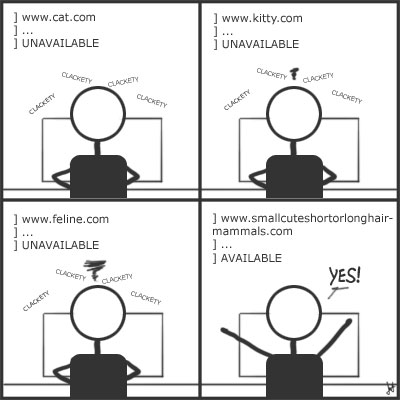
Weekend Comic - Buying a Domain


© Jeremy Buehler and Rogue Tendencies (www.roguetendencies.com) 2010.

Thursday, March 11, 2010

SCRM Tips from the Games Industry

I recently joined Altimeter Group's Jeremiah Owyang's social customer relationship management (SCRM) Google group 'Social CRM Pioneers' to keep tabs on the fledgling market.

SCRM is the combination of the social Web and customer relationship management, or in other words, taking the information people make available through social networks and putting it to good use in business processes. This can be as simple as listening to product improvement suggestions and implementing the best in the development cycle, and as complicated as trying to gauge and manipulate public opinion about a company and its practices.

Of course, all of SCRM depends on people using the right tools for the job, and there are many software companies and consultancies trying to make a name for themselves in the space. (I won't list any here; if interested head over to the group and see who's talking sense). The success of SCRM is dependent on an adaptable corporate culture flexible enough to make use of it, and savvy enough strategically to maintain clear vision and direction without falling victim to the emotion social input can convey.

Having spent time in the games industry, I feel gaming companies and audiences are ahead of the SCRM curve. This makes lessons learned there potentially useful in other markets. Here are some I think apply:

Customers find effective SCRM addictive. A customer who can directly relate their input to a product change becomes more loyal and more possessive of a product. Validation leads them to make an emotional investment in how the product grows. They will return with more suggestions for improvements or changes as they become part of what is built.

Carefully actively listen. Active listening is key. But it's also dangerous. If a company engages in active listening without fully understanding business metrics and product performance, actively listening to your customers can lead to incorrect business decisions. For example, if your product is available in blue and red, and your customers say they prefer blue, but red outsells blue - further investigation must be made before integrating customer preference.

Beware SCRM efficiency. As SCRM matures and is fully integrated into a company's business practices, every sale becomes a relationship sale vs. a pure commodity sell. While the rewards can be greater, the burden of maintaining complex customer relationships also increases. Ultimately, SCRM will become the target of optimization, especially at enterprise levels. Traditionally, when a technology is optimized, it becomes less personal. This is a dangerous contradiction to SCRM, and violates some of the founding principles of 'social'; the personal, friendly, relaxed interactions between people.

Reward customer input. Customers will take advantage of whatever ways you give them to help with the product and practices, provided they get something from the process. 'Something' can be validation gained from seeing a suggestion put to use, or by allowing them to maintain a presence on a corporate platform (such as a discussion forum or facebook page). It can also be a direct reward, such as a product discount or privileged access to information about products.

There's a lot to learn from game company SCRM strategies. Success comes from determining the best methods for collecting, measuring and sharing data and leveraging it to create better customer relationships, products and services. Regardless of the industry, as with any social technology, flexibility and adaptability are necessary corporate traits in order to capitalize on the benefits of effective SCRM.

© Jeremy Buehler and Rogue Tendencies (www.roguetendencies.com) 2010.

Wednesday, March 10, 2010

Social Games Offers: All That Glitters...

I found this article published on Techcrunch about a Comscore study concerning giving gamers the chance to perform marketing actions in exchange for virtual currency in social games. Here is the gist of it:

35% of the survey respondents said that they engage in "marketing actions" to earn virtual currency (such as watching a video, filling out a survey, etc.), and 53% said they be willing to consider marketing action for currency if given the choice.

Studies like this really bother me. First of all, the study was sponsored by Offerpal, one of the companies with a product that lets social game developers integrate marketing offers into their games. Let's gloss over the blatantly obvious conflict of interest here and, for a brief moment, take the results at face value.

To the author's credit, from a gamer's perspective marketing offers are a more appealing solution to getting game currency than handing over a credit card and making a real cash purchase.

And I suspect that such companies as Offerpal will continue to provide evidence that yes, users do in fact use offers to get game currency if they are available.

But what they won't ever make public is any unbiased analysis - an audit, if you will - of what value the offer sponsor gets from these offers.

Every gamer is predisposed to game an existing system, i.e. learning a system and taking advantage of it. That's what makes them good gamers. Whether it means clicking on a link to get currency and immediately closing the opened page, providing a fake or spam email address, switching browser tabs while an ad plays, or clicking random answers on a survey, a gamer will get their currency using the path of least resistance.

Ergo, there is very little return on marketing investments made through these offers. But that won't stop Offerpal, and companies like it, from selling the fake ROI for as long as they can milk it.

© Jeremy Buehler and Rogue Tendencies (www.roguetendencies.com) 2010.

Tuesday, March 9, 2010

Community Management and Customer Service Must Work Together

Community management and customer service are two distinct areas of a Web business, but when it comes to communication it is vital they act as one.

For example, a Web startup I worked at broke this rule. It segregated the two customer-facing roles:

Customer Service had a team of four customer service representatives (CSRs). They would take all inquiries through the Web product via email, had an on site presence, moderated the technical support area of the official forum and were available via 'live chat'. Customer service's primary roles were policy enforcement and technical support.

Community Management consisted of a community manager (me) and worked out of the marketing department. The community manager was available through email, instant messenger, had an on site presence, and moderated the official forum. The community manager was responsible for consistent messaging between the company and its customers, hosting on-site events, addressing questions about company and product direction and played the role of customer ombudsman. Community management's primary roles were communications and public relations.

In the beginning both groups operated in their own silo, sealed away from each other. Needless to say, it was not very efficient or effective. The CSRs would tell customers one thing, and community management would tell them something else, and vice-versa. Community management was faster to respond to customer inquiries in most cases, which created further inconsistencies. Finally, both teams were very bad at telling each other what was going on.

The result? The customer experience suffered, influencing the business's success. If I could go back in time, I would make these changes to how the two groups were structured:

Clear communication is priority one. Not just business to customer, but internally. The two teams should be set to work together from the beginning, with a simple technological solution to assist working together. Whether it be a SharePoint-style site, or intranet of any kind, information must be easily shared between teams so the customer is never confused by mixed messaging.

Response time is vital. In a real-time world, both groups must strive for immediate responses to customer inquiries. On the customer service side, automated responses via a ticketing system with a tracking number and a canned message is enough, because it's something. On the community side there will be times when it will be necessary to cover for the customer service team. Statements should be prepared outlining how the customer's problems are a priority and are being dealt with in sequence.

Prepared communications. Ultimately, community management drafted a set of canned responses to customer inquiries to help customer service with business and product direction. These had to be created as new customer issues would arise. Also, community made room for technical guides, etc. on the official forum to help users through issues they were having with the product. The teams got in the habit of talking to each other, and updating each other about potential issues on the horizon.

One decision maker. The customer service group had a lack of leadership. As a result, they had four different 'bosses'. Singular direction is important because any confusion is passed on to customers.

Preparing community management and customer service to work together will keep the company's responses timely and messaging clear. Be proactive, because winning a customer back is harder and more expensive than winning them in the first place.

© Jeremy Buehler and Rogue Tendencies (www.roguetendencies.com) 2010.

Friday, March 5, 2010

Web Advice for Small Businesses

The following tidbits of wisdom were hard-learned by me over 15 years of involvement with Web marketing and development:

Know what you don't know. When entering discussions with a Web services company, know what you don't know. Chances are you're a business person who knows their business very well. Don't push it. Leave such areas as technology, Web marketing, etc. to those who make it their business. Reciprocal respect in the early stages of a business venture between all parties involved will mean more listening, less babble, and a better planned project.

Beware the entrepreneur. The entrepreneur in question could be you. Entrepreneurs are people with a strong hands-on approach, and a clear vision of what they want. Sadly, sometimes clear vision comes with a pair of blinders. Be open to new ideas and directions for your Web project to avoid returning to the drawing board a year later to pay twice for work that should have been done up front. Be prepared to hear alternatives for the ideas you've constructed. It will save frustration and costs down the road.

Be aware of timing. It may be the right time for a Web site, but the wrong time to push for customer integration or large scale web marketing. Alternatively, it may not only be the right time to 'add' to your initial Web concepts, it may be foolish not to. Bounce ideas off your Web partners to help make sure your efforts are neither 'too big' nor 'too small'.

If you build it, they might not come at all. Don't create a Web entity on the off chance your customers will migrate to the platform on instinct. The Web is part of many businesses's day-to-day operations, but assuming your customers will use the tools you give them can be overly presumptuous. Understanding your customers habits, wants and business processes can save in planning and development costs.

Don't lead with technology, lead with business sense. Don't be suckered by flashy Web goodness. Video, slick graphics, bleeding edge Web technology is sometimes amazing but can also be of little value on business Web sites. Lead with an understanding of what your customers want, and give it to them with strong attention to simplicity and functionality. Its okay to look good for the party, but don't over-dress.

Know your vocabulary. When venturing onto the Web, make sure you speak the same language as your partners. Your vision of a 'portal' for example, is not necessarily anyone else's. Ensuring you and your partners speak the same language will heighten all parties' understanding of the project and its expected results.

Is something better than nothing? More often than not, the answer is no. Web users are notorious 'once bitten, twice shy' people. A poorly thought out Web tool can hurt your transition to Web business practices more than it will help. A focus group of potential Web customers or users will tell you more about your project's chance of success at both the planning and 'first draft' stages than any consultant will.

Your users will tell you what they want. If you give them the opportunity to – and that doesn't necessarily mean asking them. While a focus group, questionnaire or business lunch will give you amazing, and sometimes very straightforward information about what your users want, there are other ways to understand their needs. Close examination of their business processes, purchasing behaviors, interaction with support staff, and commentary in public forums (media, social media, Web forums, etc.) will yield many clues on how to create a Web success for your customers.

Many are greater than one. Placing yourself in your customer's shoes and examining your competitors and other aspects of the business community they find themselves in can yield information about what they will expect from the Web tools you build for them. Take advantage of the public nature of the internet to see what your customers see, and compare that vision to the entity you represent. How you fit, where, and the manner in which you fulfill a customer's needs can be influenced by understanding their virtual surroundings.

Don't create obstacles. Building barriers, restricting information, creating control structures, and other limitations on your customer's behavior on your Web site runs the risk of alienating them from the service you provide. Don't be your own worst enemy on the Web. Put your customer's needs first.

Have the resources. A poorly supported Web entity means that, over time, more and more customers will become disenchanted with it. Avoid the 'build once' mentality. No matter how much you and your partners prepare for your customer's business online, a year's worth of usage will yield new business needs and opportunities. Have the resources, both human and financial, available to address them and avoid stagnation.

Look within. Changing your customer's business practices and Web-enabling them means your company has to change and be prepared to support them. This means corporate change. Support your Web efforts with an inward eye closely watching human resource problems, business processes that bottleneck, etc. These are problems that will evolve over time, after your Web site launches – regardless of how prepared you were pre-launch.

Admit your mistakes. Sometimes you will be tempted to brush an internet tool or service under the rug and forget about as a costly mistake. Don't forget your customers are watching your every move on the Web. Sometimes admitting the shortfalls of a service will earn you respect from your customers where otherwise they might have ignored you in favor of a competitor. Having a plan for improvement or a clear path for your customers to follow as an alternative to the service you're no longer offering will also make for a better Web image.

© Jeremy Buehler and Rogue Tendencies (www.roguetendencies.com) 2010.

Friday, February 26, 2010

Signs Your Start-up is Dead

Focusing my career on Canadian Web and technology start-ups has been both boon and burden. Statistically any start-up junkie will likely see more companies fail than succeed. Fortunately, the process of failure is very educational. Here are some of the signs of the 'end' as I've experienced them:

The Beginning of the End - Death begins early in the company's lifespan, usually rooted in a bad staffing or technology decision. Signs of a problem executive team can surface as tension in meetings, backstabbing and second-guessing peers.

Cognitive dissonance amongst executives (the process by which people convince themselves a decision is correct to the extent of making all other options falsely unfavorable) is another sign. One startup used a technology for a complex Web site because it worked at a different company. A year passed before the executive team made changes to fix the costly problems it caused, but it was too late.

The Danger Zone - The original business plan isn't working, and it's time to adapt and turn failure into success. Most of the mistakes made creating the business have manifested and must be dealt with. Executives plan and reposition.

Staff must align to a single potentially successful goal, and thus the company-wide meeting to 'get everyone on the same page' is held. Attending staff are usually in two camps: Those who are ignorant and start to question why changes are necessary, and those who are aware and have their own opinion on strategy. These meetings tend to divide rather than unify.

Other signs include: Switching corporate health plans, removal of snack machines and other creature comforts, excessive scrutinizing of minor expenses, bizarre staffing prioritizations (such as hiring 'miracle workers'), hyper sensitivity to office hours (including smoke breaks and lunches), and a light first round of layoffs (usually of people who are extraneous) with decent packages.

Get Out, Get Out, Get Out - This is a desperate stage where big changes are made to buy time for product/sales to bear fruit. Signs include mass layoffs with minimal packages, closed door meetings with occasional heated arguments and weekend crunch time. Employee morale hits rock bottom, and people wonder whether they will be paid on time. The CEO desperately scrambles for funding. Bad product changes are viewed as coffin nails. Tier one staff take jobs elsewhere. Key staff are promoted with titles to keep them.

It's Over - At this stage the company is running with a skeleton staff. Assets are inventoried yet begin to go missing. Paychecks are no longer electronically deposited. Arriving at work and being able to access the office is seen as a positive. Each remaining staff member fulfills multiple roles. Each meeting is potentially 'the' meeting. Lunches are long, and nobody cares.

© Jeremy Buehler and Rogue Tendencies (www.roguetendencies.com) 2010.