Showing posts with label geek. Show all posts

Tuesday, March 23, 2010

Feel Good Technology Stories

I like reading feel-good technology stories. They bring out the best of the geek in me. Here are three of my favorites from the last 48 hours:

Efficient Desalinization. MIT scientists developed a desalinization chip that could one day provide clean drinking water to remote villages with only a solar power source to drive them. Read the story at PopSci.

Privatized Space Flight for the Rest of Us. Well, for those of us who can afford the $200k ticket price (which, coincidentally, takes the 'me' out of 'us'). Virgin Galactic's Enterprise took its official maiden flight and landed safely. Besides looking fantastic, the space ship will one day ferry six passengers into space via a high altitude launch and rocket push. See pictures and story at Fast Company. Virgin apparently collected $45 million from 330 passengers booking flights so far.

iPhone Opera. This is more of a 'dare to dream' than a true feel-good technology story, but Opera submitted a version of its mini browser to the iPhone app store. If Apple allows the browser onto the platform, it will be a spark of hope for those of us who wish the platform was more open and competitive. Read the story at Read Write Web.

© Jeremy Buehler and Rogue Tendencies (www.roguetendencies.com) 2010.

Sunday, March 21, 2010

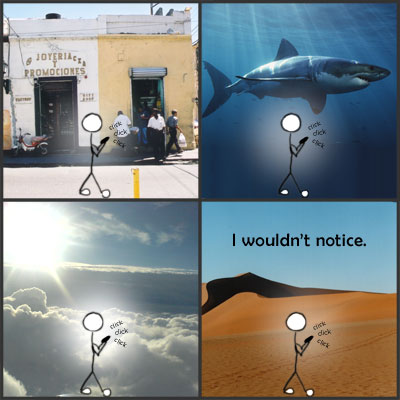
Weekend Comic - The Chatwalker


© Jeremy Buehler and Rogue Tendencies (www.roguetendencies.com) 2010.

Sunday, March 14, 2010

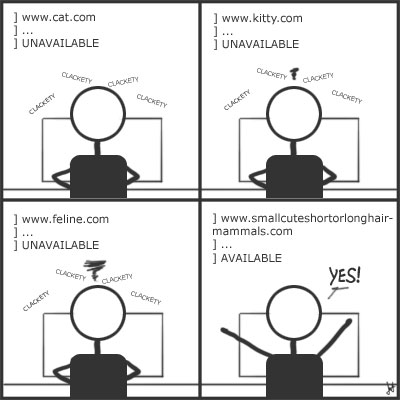
Weekend Comic - Buying a Domain


© Jeremy Buehler and Rogue Tendencies (www.roguetendencies.com) 2010.

Wednesday, March 3, 2010

On Time Spent Playing Online Games

Yesterday an article was published on Gamesbeat quoting an NPD Group report outlining January statistics about video game sales and the amount of time people spend playing online games. The gist of it:

Market researcher NPD Group said that the average number of hours spent on online gaming has risen for the third consecutive year. That bodes well for this fast-growing segment of the game industry, which includes everything from casual online poker games to hardcore multiplayer online matches on the game consoles.

The statistic is promising for the games industry, but how much can online gaming change society?

World of Warcraft, the most successful PC-based Massively Multiplayer Online Role-Playing Game of all time boasts in excess of 11.5 million subscribers, a small number compared to the world's current population of 5.6 billion people. It's a number that doesn't carry a lot of weight until you start doing some good old fashioned math.

First get statistics from Xfire, a game community and chat program that tracks the time its users spend playing games. Warcraft is their top game in terms of time spent for the last 1,615 days. Daily, 57,572 people using their service spend 15,790,298 minutes playing the game. That's 4.6 hours per person.

It's not accurate to apply these numbers to all 11.5 million subscribers, but it's fair to compare the 4.6 hours a day spent playing to the more than four hours a day the average American watches TV. Then take into account the thousands of other online diversions available, from Farmville to Poker, and it becomes easy to see how powerful online gaming is and how it is infiltrating society.

I believe that power will result in cultural fallout and societal change. The trick is to pick what the 'tipping point' will be: the point at which that power manifests in society.

I think it will be when virtual achievements gain status in the real world. This can already be seen in game communities where top gamers get hero status, but it will be a tipping point when online achievements change the real-world status of the average Joe.

Put another way, anyone can play an online game, and become notoriously good at it inside the game world. But the tipping point will have occurred when that person feels no societal restriction on wearing a t-shirt with his gamer name on it in public. Another sign could be that it becomes acceptable and preferable to use ones real name instead of an alias when competing online.

It's hard to imagine the world after the tipping point because the gap between the real world and the virtual world is significant. As time progresses, and as technology evolves, the gap narrows. I don't think my generation will see it, or even the next. But their children will grow up in a world so vastly technologically different that its possible, and even probable.

© Jeremy Buehler and Rogue Tendencies (www.roguetendencies.com) 2010.

Tuesday, March 2, 2010

One Person's Privacy...

I dislike location-based mobile applications that pinpoint a user's location on a map. A user typically 'check's in' at the locations they visit, and other approved users on the service can see where they are in close to real-time. Products in this genre include such applications as FourSquare, Google Latitude, Loopt etc. and usually combine a cell phone's GPS and meta data to create a service-oriented social application.

I agree there are some fantastic opportunities created by these applications. Augmenting reality is an area of technological development I find fascinating and exciting, and these applications certainly augment. There are opportunities in tourism, social, education and my favorite, gaming.

These applications are also dangerous because they threaten personal privacy. My enthusiasm for new technology would probably blind me to these threats if it wasn't for an experience I had early in my career.

I was working as Assistant Editor of a Canadian IT trade publication and the company that ran it had an in-house art department. The creative director was an older man who had grown up in post-World War II Poland.

I was having lunch with him and telling him about this fantastic new technology I'd just covered in a recent story. The story was about Radio Frequency (RF) tagging, the process by which a tag is added to a product, security card, etc. that emits a radio frequency that can be monitored by sensors. The advantage to the technology is that it allowed everything from shipping companies to retail stores monitor the location of their product in real-time.

One of the applications of the application I told him about was the high-tech house Bill Gates built back in the '90s. It would display images on the walls and play different music in a room based on the tag worn by an occupant. This would guarantee no matter where a person went in the house, their favorite art and music would follow them.

I was giddy with excitement about the possibilities of such a technology. So much so, I failed to notice the creative director was about to lose it. And he did. He explained to me in harsh tones that such systems can give governments too much control; that it was dangerous to be marked; that it is a terrible violation of freedom.

His experiences included a world I had not been exposed to and the emotion he displayed served as a swift kick to my sensibilities. The negative what-ifs began to come to mind. Oppressive governments, stalkers, burglaries, social profiling, playground mocking, terrorism, all the big and little negative twists to what had been up to that point, something very cool.

I view these location-based mobile applications in a similar light. The technology is cool. And there are many great and positive uses for it. But not everyone in society will use the tool as is intended. We must be cautious.

© Jeremy Buehler and Rogue Tendencies (www.roguetendencies.com) 2010.

Monday, March 1, 2010

Google Wave vs. Google Buzz

I find myself trying to use both Google Wave and Google Buzz products because I believe in the overall approaches to communication taken by the Google platform. However, I think they will one day converge into a better-executed single product.

Some won't like me comparing the two as they are built for different purposes. Google Wave is a real-time collaboration and communications tool. Google Buzz is essentially another news feed, as made popular by Facebook. A short list of key differences between the product would include:

1) Real-time. Wave is a (very) real-time product, Buzz is not. There is a delay on Buzz posts, especially through linked sites. Wave is real-time letter by letter.

2) Closed environment. Wave is a closed environment, like email, Buzz is not. Buzz can list content from Blogger sites such as this one, Picasa feeds, Twitter, and more. Wave will have the potential to use Wave-friendly widgets, but these will require external development.

3) Linear communication. Wave is non-linear communication, while Buzz is. Wave uses an elaborate playback scheme to run users through a conversation from start to finish. Comments on a wave can be made at the beginning, end, middle, or privately - there are no limitations. Buzz is far more structured. Comments are locked in a sequential stream.

I think it is easy to see how the two products could cross over. In Buzz I envision a targeting feature, allowing one to direct a post to a specific user and make it private. In Wave, I see developers creating plugins that automatically feed a user's tweets, etc. to user lists.

The question is, which product will be more easily digested by users? Buzz took one on the chin with a very sloppy release that invaded users' privacy. Wave had a very rough time of it too as users tried to put it in context.

My pick would be to Wave-ify Buzz, based on user familiarity with the news feed experience. Facebook is doing a lot to educate a marketplace (400 million users strong, and growing) on how to interact with a news feed, and taking advantage of it would be the smarter and cheaper thing to do.

I would like to be a fly on the wall at Google and see how the products are viewed from development, positioning and competitive standpoints.

© Jeremy Buehler and Rogue Tendencies (www.roguetendencies.com) 2010.

Thursday, February 25, 2010

Birth of a Whale Meme?

If a company figures out the magic formula for consistently producing long-lasting memes, it will quickly become the most successful marketing company of our time. It takes more than great creative. In fact, what it takes is a rather complex set of factors that some have tried to scientifically dissect.

I would argue there are more factors:

Shock - At some level, the meme has to jar the audience. It has to be outside the status quo. A cat is not a great subject for a meme. A cat asking for a cheeseburger is.

Delight - The audience must delight in what they see. If the shock factor is based in horror or revulsion, the meme will not be as effective. A delightful response is more conducive to sharing. The exception to this rule is a meme aimed at a cultural sub-group, where it can become an 'inside joke'. For example, a meme that spreads amongst university students who are trying to gross each other out.

Technology - Memes that are conveniently packaged are potentially most viral and most successful. For example, private companies that create a meme but hide it behind a user log in, or memes that require a specific technology to be viewed are not going to be successful. The best memes are those that grandma can email to her friends.

Let's apply this meme framework to the recent tragic death of Dawn Brancheau, Seaworld whale trainer, at the hands (jaws) of Tilikum, one of the Shamu whales, to see if it will become a successful meme:

Shock - A killer whale eating its trainer is definitely outside the status quo, and will jar an audience.

Delight - Some people will be delighted by a whale kept in captivity lashing out at its 'Oppressive Human Overlord', however, this will not be the primary instinctive response by most. No delight here.

Technology - There is nothing to share. There are still images available of Dawn and Tilikum prior to the attack, but there is no video or images of the attack available at this time. If a meme evolves, it will be based on creative formed around the incident and not stem from it directly.

Evaluation based on these criteria shows the incident could spawn a meme that will be popular amongst some people, but it will not be wide-spread.

© Jeremy Buehler and Rogue Tendencies (www.roguetendencies.com) 2010.

Wednesday, February 24, 2010

Farmville and Perpetuity

People die. We do our best to stave off the inevitable, but inevitably death happens. When I go one of my final thoughts will not be 'at least my Farmville farm will live on in perpetuity'. But it will. My friends will be able to feed my chickens and fertilize my crops until someone decides to flip the almighty switch.

This perpetual existence is a problem for today's social game designers but not because of the implicit database overhead of game accounts belonging to dead people. I can guess that when Farmville was originally designed, no one on the design team knew how popular it would become.

My game design experience led me down a practical path with Farmville. I made an Excel spreadsheet as I played and mapped out the ROI of every type of crop. I quickly converted my property into an industrial farm, picked the best crops, and logged in religiously to fast-track my progress. Soon I was ranked first amongst my few friends who played.

It was a simple Farmville time. There were seeds, trees, sheep, cows, ducks, fences and not much else. The game was easy to understand. I played, contentedly, for 39 levels. During that time the game became more complex. At level 37 I noticed the game design flaw that proved the Farmville designers did not expect its phenomenal growth.

At level 37 there was only one more gift to attain, leaving experience points as a weak motivation for continued play. The designers had to scramble to build in ways to keep people engaged at the 'end game'. Like all designers in a pinch trying to make a product do something it wasn't meant to, the Farmville team complicated things.

I recently visited my mostly retired farm to explore the horse barn and storage expansion concepts. I could not figure out the horse barn without asking someone how it worked. And apparently my friends are having difficulty coordinating enough people to expand their storage facilities.

Let this be a lesson to designers of future Facebook games: Facebook games must be built assuming a perpetual lifespan. Easier said than done, as we live finite lives and the concept of perpetuity is unnatural. But as time played equals emotional investment, and emotional investment equals trust, and as trust is a predetermining factor in making purchases online, designers need to create simple and engaging perpetual 'end games'.

© Jeremy Buehler and Rogue Tendencies (www.roguetendencies.com) 2010.